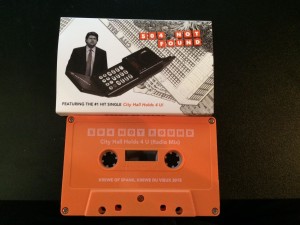
The Cassingle!
The krewe captured the entire theme at the 504 Not Found app site (probably NSFW, just a heads-up), and you can see reviews of the parade itself (including pictures of the spectacular float) in a few different locations:
For this throw, I took the stellar graphics and script from some of the other krewe members and a preferred-to-stay-unnamed vocal talent and put it to music. Since we had to face the fact that most folks don’t own cassette players anymore (although the good folks at National Audio Company and Cassetro came through like champs to produce the cassettes for said players), the krewe also made the audio part of the app, and I’ve posted it on my SoundCloud. Enjoy.
[soundcloud url=”https://api.soundcloud.com/tracks/189229432″ params=”auto_play=false&hide_related=false&show_comments=true&show_user=true&show_reposts=false&visual=true” width=”100%” height=”450″ iframe=”true” /]
[soundcloud url=”https://api.soundcloud.com/tracks/189229597″ params=”auto_play=false&hide_related=false&show_comments=true&show_user=true&show_reposts=false&visual=true” width=”100%” height=”450″ iframe=”true” /]
The Playboy Psychonauts validated this rule last month with a weird one-off reunion at IndyPopCon. I would already be in town for work, so the timing was right. And why not stage a reunion show at a place the band never played before (the Indianapolis Convention Center) for a group of folks who never experienced the act before (since the band stopped playing three years earlier and we never focused on conventions). Everybody loves sitar-based lounge covers with a weird twist and no vocal audience interaction! CAN’T MISS. Add the fact that I had to borrow a guitar strap from headliners Paul and Storm (SO PROFESSIONAL), and we were set for glory!
While the reception was indeed pretty positive (I wish I could find the successive tweets that birthed an initial reaction of #sitarfunkfail and the next tweet where we finally won them over, but Twitter won’t let me search for that hashtag – HOW DO YOU LOSE THE #SITARFUNKFAIL HASHTAG?!), the whole event made it worth it to meet Joel Hodgson from Mystery Science Theater 3000 and receive some good words about the music we don’t know when we’ll play again. Which was also fun to explain to the folks who bought the album after the performance (I couldn’t resist the mention of the Bandcamp site and an added “Hodor” – I knew the crowd).
So there you go. Until next time.
(Photo courtesy of Mark Rice)
]]>- Visit said store
- Get to the gig early and realize parking was awful due to the fun run/festival downtown
- Discover my nearly flat tire
- Look for the jack (also taken out of the car with the guitar stand during a car detailing – at least it wasn’t my fault)
- Get everything aired up enough to get to a tire store
- Wait for the tire replacement
- Get back downtown
- Walk too far due to the aforementioned festival parking situation
- Play a decent gig
- Drive back to New Orleans
- Figure out how to reset the low tire pressure indicator so that it didn’t keep coming on and freaking me out at 3am on the drive through rural Louisiana
I write now because enough distance and time exists between said occurrence and now. And that’s why I always leave early – for crappy stuff like this. From now on, guitar stands are my canary in a coalmine.
]]>The close relationship to luxury brand names, the reinforcement of exorbitant price points, the promised access to “forbidden” or otherwise inaccessible goods – it’s all there. But if it’s going to sit in a glass case and do nothing, it’s worthless. It’s non-functional. You can own one of Eddie Van Halen’s guitars and be no closer to the “Eruption” solo than you were on a Mexican Strat 30 years ago and weren’t practicing then, either.
Famous Stradivari instruments may be rare investments, but they get played. By professionals. In public and for the enjoyment of audiences. The instruments in this publication are nowhere near as old or valuable, and they don’t deserve to be shut away and made useless for the sake of possession. There are much more lucrative investments, anyway.
]]>- four tracks of bass
- slap bass attempting to replicate a bass and snare drum
- palm-muted and thumbed bass for the bass line
- some chords in there
- the lead line
- I play the wrong instrument to be in a brass band, so I had to make some adjustments
- I’m a transplant – please forgive any trespasses. I just heard the song and tried to make it work as a solo bass piece
- Happy Mardi Gras!
TechCrunch announced Amazon’s AutoRip service today, basically giving you a central storage area for all the songs you ever purchased in any form from Amazon. That means you can now store your music collection in one of three central areas – Apple servers (for a fee with Match), Google (free for their purchases, to a limit for everything else), and Amazon (basically stuff you bought from them).
Meaning that media matters little anymore. Doesn’t matter how you bought it, these three will make it convenient for you to get.
Why? Because they want you to buy from them in the future. They want their place to be instinctual for you to visit and to purchase from.
Seems nice, but we’ve seen people pull right back for this kind of media before (right, Amazon?). So I still plan on syncing my server to Google Play for mobile use that still leaves copies for my own personal satisfaction at home.
I’m more intrigued by seeing exactly what I’ve purchased from Amazon. And a little creeped that they remember better than I do.
]]>- Cheap.
- Recyclable
But isn’t it time to move beyond smashing instruments at this point, even those designed for that purpose? You have better things to do with your stage time than create excess splinters. Just sayin’.
]]>That is to say, why do we need to make albums? Music existed for eons before the standard long-playing record, 8-track, cassette, or compact disc came around. Before these modern inventions, you still had grand orchestral pieces, chamber music, folk songs, and all manner of forms (and that’s just tackling the Western forms – what about ragas, gamelan music, or other pieces that exist outside the Western art music?). The music was sacred and secular, long and short, loud and quiet. There were accepted forms, but you could pick and choose among them.
Even in the 20th-century United States music business, albums only took precedence in the last third of the century. Before that, you had singles (and before that, mass-produced sheet music) to spread the hits. As technology expanded the sonic quality and quantity of the music you could place on a recording medium, albums rose to take prominence in the music business. Nature and record companies abhor a vacuum. Artistic conventions arose around the creation of an album, but there were also economic concerns:
- Do you release the double album or shrink it down to a single album?
- Do you release more than one album in a year?
- Do you have a single on the album to help sell the whole shebang?
CDs meant more music could reach the public at one time, but the above concerns still applied. And there was still concern about physical packaging and distribution with CDs, even as production costs came down.
Obviously, the production and distribution costs are much different for digital distribution, but it also changes the production cycle of music. There’s no need for the production build-up to release to support cycle that the music business used for albums. Artists can maintain an always-on connection with their fans, or they can take their time and release on their schedule. They can use just about whatever means they want to create and distribute their music – the sky is the limit. Artists can make whatever they want to out of the music.
So why focus on musical artists making albums? The time, economic, and physical limitations that required the production of albums are gone. Home studios are cheaper and more plentiful, so recording budgets and time limits don’t have to be as rigorous. Because the budgets can be lower and artists don’t have to work with labels for distribution now, the initial investment doesn’t have to be as large. And because there’s no need to produce physical product for album releases, you can send out as much or as little music as you want at any time.
But this isn’t to decry the album as a format, though – hell, the band I’m in is recording one for vinyl right now. It makes sense for that band – it’s kind of a retro act with a lounge vibe, so the vinyl recording makes sense. But that’s an artistic decision, not a mandatory requirement. Artists don’t have to limit themselves to a format, long or short. Now that it’s inexpensive and only as time-consuming as the artist wants it to be, it makes sense to think beyond the album. Let the creative process run beyond a format designed for technology of a few years ago (at the very least). Imagine new forms, put your heart into it, and see what happens. It’s not just something like iTunes albums, with some additional material and the like. Re-imagine how the music should be presented, and think about everything that goes into it.
And yes, because it’s relatively different territory, there are going to be challenges. And people are going to not like it – personally, I hated “Avatar” (possibly because I saw it in 2D, non-IMAX format and was forced to focus on the “plot”). But artists don’t have to worry about selling to everybody anymore, either. Artists can reach their audiences more directly with a smaller investment now. You can exercise the same focus on a smaller project, reach exactly who you want to, and not worry about the larger scope.
The above points aren’t anything new – I guess I’m just surprised that albums are still as predominant as they are. It’s an artificial construct that can be quite fulfilling, and great albums are truly a wonderful thing. But they don’t have to be the only thing, and there’s so much more to be done.
]]>Unfortunately, WOXY doesn’t seem to be faring as well, and that’s a damn shame. Now that the Internet has made just about every kind of music available at a moment’s notice, the people with valid, well-researched opinions and knowledge that help guide listeners are more important than ever. WOXY earned their name because of the dedication and passion the DJs and programmers put behind the station, from when it was a terrestrial station that hosted album giveaways on the Party Patio (with breakfast burritos!) to a groundbreaking Internet radio station that deserved a lot better than it got. They’ve been up and down financially since their went ‘net-only a few years back, but here’s hoping they come back stronger than before. As far as the music and the knowledge behind it, they’ve been a class operation the entire time.
]]>